
The AI-Powered Operating System for Pumping Professionals
ProHauler connects customer scheduling, route optimization, driver dispatch, service verification, and billing in one connected platform built for septic pumping businesses. Customer information enters once and follows the job from scheduling through billing.

Stop Letting Chaos Eat Your Profits
Running a pumping business without the right septic tank cleanout software means costly mistakes, wasted diesel, and unhappy customers.
Missed Service Dates
Forgetting a scheduled cleanout leads to backups, emergency calls, and lost contracts.
Inefficient Routing
Drivers zigzagging across town wastes expensive diesel fuel and limits how many tanks you can pump daily.
Manual Tracking
Paper tickets get lost in the truck cab, meaning services go unbilled and revenue slips through the cracks.
No-Shows and Forgotten Appointments
A customer who scheduled a septic pump 3 months ago forgot, the truck arrives to a locked gate or nobody home, and you've burned diesel and a service window on a wasted call. Automated appointment reminders by text fix this before the truck ever rolls.
Reliable Service Scheduling
Schedule routine pumps weeks or months in advance and never miss a service date. Our calendar keeps your whole team aligned on what's coming next.
- Schedule routine cleanouts weeks or months ahead
- Multi-day scheduling for large commercial accounts
- Block off treatment plant runs directly in the route
Most septic work is scheduled well in advance — a residential tank that's due every three years, a commercial account that needs quarterly pumping, a grease trap on a monthly health code cycle. ProHauler septic tank cleanout software lets you book those jobs weeks or months out and they stay on the calendar until they're completed. The system handles the difference between a scheduled routine pump and an emergency call without you having to shuffle the whole board manually.
Large commercial accounts that span multiple days get multi-day scheduling, so a job that takes three truckloads doesn't get split across separate entries that lose track of each other. Treatment plant dump runs get blocked off in the route so the dispatcher doesn't try to squeeze another service stop into a window that's already committed to a 45-minute drive to the plant and back. Every scheduled appointment sends an automatic text confirmation to the customer, so the homeowner knows when you're coming and the gate is open when the truck arrives. Learn more about septic service scheduling.

Route Optimization for Pumper Trucks
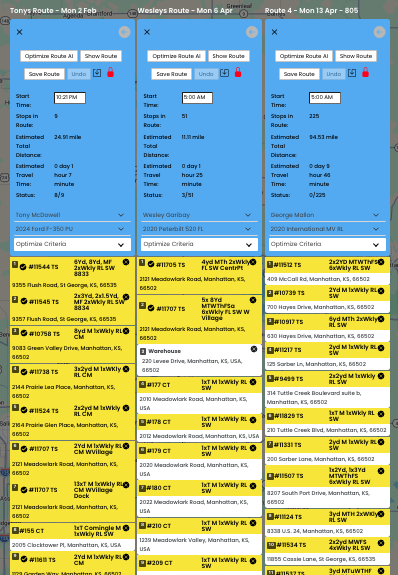
Stop planning routes on whiteboards. Our routing engine clusters stops geographically so your drivers spend less time driving and more time pumping.
- Geographic clustering to reduce drive time between jobs
- Factor in treatment plant dump location — mid-route or end of day
- Estimated time-at-site per job type
Route optimization for pumper trucks isn't just about finding the shortest path between stops — it's about sequencing jobs so you're not crossing town twice to pump two tanks that are ten minutes apart. The routing engine clusters stops geographically by zone, so a driver working the north side of your service area hits every job in that zone before looping back. That means fewer miles driven, less diesel burned, and more billable stops in a day.
The system also factors in where the treatment plant sits in relation to the route. If the plant is on the way back to the yard, the dump run lands at the end of the day. If a truck is going to fill up mid-route, the plant gets sequenced as a stop so the driver doesn't waste a half-hour backtracking. Estimated time-at-site per job type — a residential pump takes 20 minutes, a commercial grease trap takes 45 — keeps the schedule realistic. And when the owner is out driving a truck instead of dispatching, the system handles driver substitution so the route doesn't fall apart because someone called out. Explore the full feature set.
Billing Automation
Say goodbye to manual invoicing. Set up recurring billing cycles, keep credit cards on file, and auto-charge customers for every pump job.
- Invoice per-job or on a recurring cycle
- Flat-rate vs per-gallon billing
- Separate billing for grease trap vs septic accounts
Some septic operators charge a flat rate per pump job — $300 for a residential cleanout, $450 for commercial. Others bill per-gallon, especially for large commercial tanks. ProHauler septic tank cleanout software handles both billing models so you're not squeezing per-gallon charges into a flat-rate invoice template. Grease trap accounts get billed on their own recurring cycle — monthly for most restaurants, quarterly for lower-volume kitchens — separate from the septic side of the business.
When a job is completed in the field, the invoice generates automatically by email. If you keep a card on file, the charge runs the same day. For accounts that pay on terms, the system tracks what's been billed, what's been paid, and what's overdue — so you're not digging through a stack of paper tickets at the end of the month trying to figure out who still owes you. Overdue accounts trigger automated follow-up emails so you don't have to chase them manually. See septic pumping pricing strategies for more on how operators structure their billing.

Online Booking & Quoting
A homeowner notices a slow drain at 9pm, Googles "septic pumping near me," and finds your website. If they can't book online, they move to the next result. ProHauler lets residential customers book a septic pump directly through your website — they select the service type (routine cleanout, emergency, grease trap), enter their tank size and address, and get an instant price estimate based on your pricing rules for that service area.
They schedule a service window, pay a deposit online to secure the appointment, and the booking flows straight into ProHauler as a job — not a lead that someone has to call back tomorrow morning. The address, tank details, and payment are already in the system when the truck rolls out. No phone call, no voicemail, no lost customer who already found someone else by the time you call back.
For commercial accounts, the same online quoting system handles grease trap service requests from restaurant managers who need to schedule a cleanout before their next health inspection. The quote generates based on trap size and service frequency, and the job enters the system ready to dispatch. See how online booking connects to the full platform.
- Instant price estimates by service type and service area
- Online deposit collection to secure the appointment
- Booking flows straight into dispatch — no manual data entry
Recurring Service Reminders & Customer History
Most residential septic tanks need pumping every 3 to 5 years. That's a long gap — long enough that most customers forget when their last pump was. ProHauler septic tank cleanout software lets you set a service reminder cycle per customer — 3 years, 5 years, or a custom interval based on tank size and household occupancy. When the interval is due, the system sends an automatic reminder by SMS and email, so the customer hears from you before they have a problem, not after.
Every address has a full service history attached: prior pump dates, gallons pumped, any inspection notes, photos from prior service visits. When a technician pulls up to a tank they've serviced before, they can see the lid access notes, the last time it was pumped, and whether there were any issues with the drain field — without calling the office to ask.
This recurring reminder system is what turns a one-time customer into a lifetime account. Instead of losing touch after the first pump, the system keeps the relationship alive on autopilot — the reminder goes out, the customer books, the job enters the route, and you never have to chase them manually. Learn more about managing recurring septic customers.
- 3-year, 5-year, or custom service reminder cycles
- Full tank service history per address — pump dates, gallons, notes
- Automated SMS and email reminders when service is due

Driver App & Service Reports
Your drivers see their full route on their phone — every stop in sequence, with job details attached: tank location, lid access notes, gallons estimated for the job. At each stop, the driver logs gallons pumped, adds service notes, and captures a photo of the tank before and after the service. That information flows back to the office in real time, so dispatch knows what's done and what isn't without waiting for the driver to come back to the yard.
When the job is complete, the system generates a digital service report — gallons pumped, service date, technician name, any notes or photos — that the customer receives by email. No more paper tickets that get lost or crumpled in the truck cab. And if a health inspector asks for proof of service on a commercial account, you have a timestamped digital record showing exactly when the tank was pumped and by whom. See how the driver app works.
The driver app also tracks treatment plant dump runs, so you've got a record of disposal — important for commercial accounts and regulatory compliance. This septic pumping software feature is what protects you when a health department audit comes knocking.
- Route on phone with job details and lid access notes
- Log gallons pumped, service notes, and photo capture per job
- Digital service report emailed to customer — no paper tickets
Grease Trap Service Management
Many septic operators also run grease trap service for restaurants and commercial kitchens — it's the same truck, the same pump, and the same skill set. But grease trap accounts operate on a different schedule than septic: monthly or quarterly cleanouts required by health code, with compliance reports that the restaurant needs to keep on file for inspections.
ProHauler manages both service lines in one platform. Grease trap accounts get separate service records from septic accounts — different billing cycle, different service frequency, different reporting requirements. The system generates compliance reports that show when the trap was last serviced, how much was pumped, and when the next service is due, so the restaurant manager has the documentation they need when the health inspector shows up.
Grease trap billing runs on its own recurring cycle — monthly auto-charge for most accounts, quarterly for lower-volume kitchens — separate from the septic side. Managing both in one septic pumping software platform means one login, one dispatch board, one billing system, instead of juggling a separate app for grease trap accounts and another for septic.
- Recurring grease trap cleanouts — monthly or quarterly
- Separate service records for grease trap vs septic accounts
- Compliance report generation for health inspections

Missed Call Capture & AI Receptionist
Septic emergencies don't wait for business hours. A backed-up septic system at 11pm on a Saturday is a call the customer cannot delay — and if nobody answers, they call the next company on the list. The AI receptionist answers after-hours calls, collects the customer's address and contact information, logs the emergency request, and sends an SMS confirmation while alerting you on your phone. The lead is in the system by the time you wake up, not lost to voicemail.
During the day, the same problem happens on a smaller scale: the owner is out on a service run, the phone rings in the truck, and nobody answers. The AI handles those daytime calls too — quoting routine cleanouts, answering pricing questions, booking appointments — so you're not losing the residential customer who called while you were elbow-deep in a tank. Learn how to get more septic leads with after-hours call capture.
Every call gets logged with a summary — what the customer asked, what was quoted, whether a job was booked — so there's no guessing what happened on a call you couldn't take. No after-hours emergency jobs lost to the competitor who picked up.
- 24/7 after-hours emergency call capture
- Collects address, logs request, sends SMS confirmation
- Daytime call handling when the owner is on a service run
Built for growing pumping professionals
We didn't just build software in a vacuum. We're experienced SaaS developers who started our own hauling business. We know exactly what it takes to manage assets and recurring routes, and we built ProHauler to be the connected operating system you need to scale without scaling your office staff.
What septic operators are saying
Pumping pros who switched to ProHauler septic tank cleanout software share what changed in their day-to-day.
"I've been pumping tanks for 18 years and I was still doing invoices by hand. ProHauler changed that in the first week. Now the invoice goes out the second my driver marks the job done — I stopped chasing paper tickets altogether."
Dave M.
Blue Ridge Septic, Asheville, NC
"We run 30 grease trap accounts on top of our septic routes. Before ProHauler, I had two spreadsheets and a calendar. Now both service lines live in the same dispatch board and I stopped missing quarterly cleanouts. That alone saved me two restaurant contracts."
Karen T.
GreasePro Services, Mesa, AZ
"The 3-year reminder system is worth the subscription by itself. I used to lose customers because they forgot to call me back. Now the reminder goes out automatically and they book online. I picked up 14 repeat jobs last quarter that I would have missed."
Ray D.
DownHome Pumping, Lubbock, TX
Still running your pumping business the old way?
| Operational Scenario | The Old Way | The ProHauler Way |
|---|---|---|
| Booking a new residential pump job | Take a message, call back, hand-write the appointment in the calendar, hope you remember to tell the driver. | Customer books online, pays a deposit, and the job is in the dispatch board before you even see it. |
| Reminding a customer their tank is due | You don't. They call you three years later when it's already backing up, and you've lost the recurring relationship. | Automated 3-year reminder goes out by text. Customer books online. The job enters the route on its own. |
| Building tomorrow's service route | Spreadsheet with addresses, a paper map, and your best guess at drive times between stops. | Route engine clusters stops by zone, sequences the treatment plant dump, and estimates time-at-site per job. |
| Handling an after-hours emergency call | Voicemail. The customer calls the next company on the list while you sleep. | AI answers, logs the address, sends an SMS confirmation, and alerts your phone. The lead is in the system by morning. |
| Sending an invoice after a job | Paper ticket in the truck, transcribed into an invoice at the end of the week, mailed or emailed whenever you get to it. | Driver marks the job done with gallons and a photo. Invoice generates and emails automatically. Card on file gets charged same day. |
| Tracking which grease trap accounts are overdue | A separate spreadsheet that nobody updates until a restaurant calls complaining about a missed cleanout before their inspection. | System flags every account past its service interval and shows you exactly which traps need scheduling this week. |
Missed recurring customers are the silent killer of a pumping business — they don't call to complain, they just disappear and you never know you lost them. Wasted drive time between poorly-sequenced stops burns diesel that comes straight out of profit. And invoices that never get sent because the paper ticket got lost in the truck mean you're doing the work for free.
The right septic tank cleanout software eliminates these problems — not by digitizing the paper ticket, but by connecting the scheduling, the route, the driver, and the billing so information moves through the business instead of getting stuck on a clipboard. Book a demo to see it in action.
Simple pricing for pumping businesses
ProHauler septic tank cleanout software is priced for every stage — from a single-truck owner-operator to a multi-truck regional fleet running septic and grease trap service lines. No per-user fees, so your entire team is included in your subscription. See full pricing details or book a demo to find the right plan for your pumping operation.
Frequently Asked Questions
Ready to Optimize Your Pumping Routes?
Join the growing number of septic businesses using ProHauler to cut fuel costs, eliminate missed jobs, and scale operations.