
Small Does Not Mean Simple
The most common mistake in small-fleet software selection is treating fleet size as the only measure of software requirements. It is not.
A company may operate only two trucks but provide residential trash, commercial dumpsters and roll-off dumpsters. That company may have more complicated operational requirements than a larger company operating a single service line. Recurring routes, on-demand rentals, container movement, billing models that differ by service, and customer communication across multiple service types all add complexity that has nothing to do with the number of trucks in the yard.
Software selection should therefore consider:
- Service mix — what the company actually does
- Recurring versus on-demand work
- Route complexity and density
- Container or equipment movement
- Billing requirements per service line
- Customer communication across services
- Driver workflows and what the driver sees in the field
- Growth plans — trucks, employees and new service lines
A two-truck company running three service lines on a connected platform can be far better organized than a ten-truck company juggling three disconnected tools. Fleet size is the wrong starting point. The right starting point is the actual workflow.
Scenario 1: Recurring Trash Service
Consider what happens when a small waste company provides residential or commercial trash service. A residential customer signs up at a service address. That customer needs to be associated with a service schedule. The service address needs to be placed on the appropriate trash route. The stop needs to appear in the driver's workflow on the correct service day. The customer may need recurring billing — monthly, quarterly or annually — and that billing should stay connected to the service record.
When another customer signs up down the street, the operator needs to determine where that address belongs within the company's existing route structure. This is fundamentally different from simply placing a customer into a generic CRM. The customer is not just a name and an email — they are a stop on a physical route, with a service day, a billing cycle and a driver who needs to see that stop alongside every other stop on that route.
Good trash service software keeps the customer, the service address, the route, the billing and the driver workflow connected. When a customer pauses service, that change should be reflected across the route, the dispatch board and the billing system at the same time — not in three separate applications that someone has to remember to update.
Scenario 2: Roll-Off Dumpster Rental
Dumpster rental creates a fundamentally different operational workflow. A customer may request a dumpster, select a container size, schedule a delivery, pay online, receive the container, request a swap, extend the rental, incur additional rental charges, and incur tonnage or disposal charges before the final pickup.
Software for dumpster rental needs to manage operational events and container movement — delivery, swap, pickup — rather than treating each rental like a recurring subscription. Inventory awareness matters: the office needs to know how many dumpsters are in the yard, how many are on rent, and when each one is due back.
The important architectural concept is this: different operational workflows should not require disconnected customer records. If the same customer has commercial trash service and later rents a dumpster for a project, the business should not have to recreate that customer in an unrelated operating system simply because the service workflow is different. The dumpster rental should behave like a dumpster rental, and the trash service should behave like a trash service — but the customer, the billing and the communication should remain connected.
Scenario 3: Multiple Service Lines
Growth rarely happens in a straight line. A small company may begin with one roll-off truck. Later it adds portable toilets. Later it adds recurring commercial trash service. Each addition is a win for the business — and a potential problem for the technology stack.
If each service line requires a different software platform, customer information becomes spread across several systems. Employees need multiple logins. Customer information has to be entered repeatedly. Billing and communication histories become separated. Management lacks a complete picture of the customer relationship, because no single system holds the whole story.
The preferred architecture is different:
ONE CUSTOMER
A single connected record across every service the customer uses
MULTIPLE SERVICES
Service-specific workflows that behave the way each service actually works
The dumpster workflow should behave like dumpster rental. The trash workflow should behave like trash service. The portable toilet workflow should behave like portable sanitation. The workflows should not be artificially forced into the same operational model. However, customer information, communications, billing, payments and business administration should remain connected where appropriate.
That is one of the core differences between a collection of single-purpose tools and a connected operating system. It is also one of the major reasons a small hauler should think beyond fleet size when choosing software.
Scenario 4: The Owner Is Doing Everything
The reality of a small waste company is that the owner is often doing everything at once. The owner may simultaneously be answering phones, selling, creating customers, dispatching, driving, managing employees, sending invoices, collecting payments, answering customer questions, managing the website, requesting reviews and marketing the company.
This changes the definition of good software. For a small hauler, the objective is not simply acquiring more software features. The objective is reducing administrative complexity and the number of disconnected systems and handoffs the owner has to manage. Every separate tool the owner has to log into, export from, or manually move information between is a cost — not in subscription dollars alone, but in time and in the likelihood that something gets dropped.
Good software for a small hauler should reduce the number of places the same information has to live. A customer who calls about an invoice should not require the owner to check three systems to find the answer. A completed job should not require manually copying service details into a separate billing tool. The fewer handoffs, the fewer errors — and the more time the owner has to actually run and grow the business.
Scenario 5: Customer Acquisition Should Connect to Operations
A customer should be able to move through the business in one connected flow:
The value of a connected operating system is not simply putting many features under one login. The value is allowing customer information to move through the business without repeatedly recreating or manually transferring the same information between unrelated systems.
A prospect who discovers the company through a professional website should not disappear into one system for marketing, another for ordering, another for dispatch and another for billing. It should be one connected customer relationship — from the first click through the final payment, the review and the next referral.
A Connected System, Not Just "All-In-One"
Many software companies use the phrase "all-in-one." The phrase has become so common that it tells a buyer very little. What matters is not how many features sit behind one login — it is whether the information and workflows actually connect.
A company can theoretically subscribe to website software, a CRM, online ordering, dispatch software, routing software, billing software, payment processing, SMS and telephone software, review software, email marketing software and social media software — and still have an inefficient operation if information does not flow between those systems. A collection of features is not the same as a connected operating system.
The difference is this: a connected operating system allows the same underlying customer and service information to support multiple stages of the customer lifecycle. The record that captures an online order is the record the dispatcher works from. The record the driver updates is the record that generates the invoice. The invoice is connected to the payment, the payment to the customer history, and the customer history to the next review, referral or repeat order.
What Should a One-Truck Company Use?
A one-truck operator does not necessarily need every feature available in ProHauler on day one. A one-truck operator should be able to start with functionality appropriate to the current business. If the company only runs roll-off dumpsters, the software should handle dumpster rental well. If the company only runs residential trash, the software should handle recurring routes well.
The question is what happens next. What happens when:
- Truck #2 is added
- A dispatcher is hired
- An office employee is hired
- Another driver is added
- Another service line is introduced
- Customer volume increases
- More routes need to be managed
- More transactions require billing
- Customer communication volume increases
Replacing a company's operating system during rapid growth creates unnecessary disruption. Data has to be migrated. Employees have to be retrained. History gets lost or duplicated. Choosing software capable of growing with the operation from the start reduces the likelihood of needing to migrate to an entirely different system later. The goal is not to buy the most features today — it is to avoid having to rip and replace the core platform at the moment growth is most demanding.
Is ProHauler Software a Good Fit for a Small Waste Hauler?
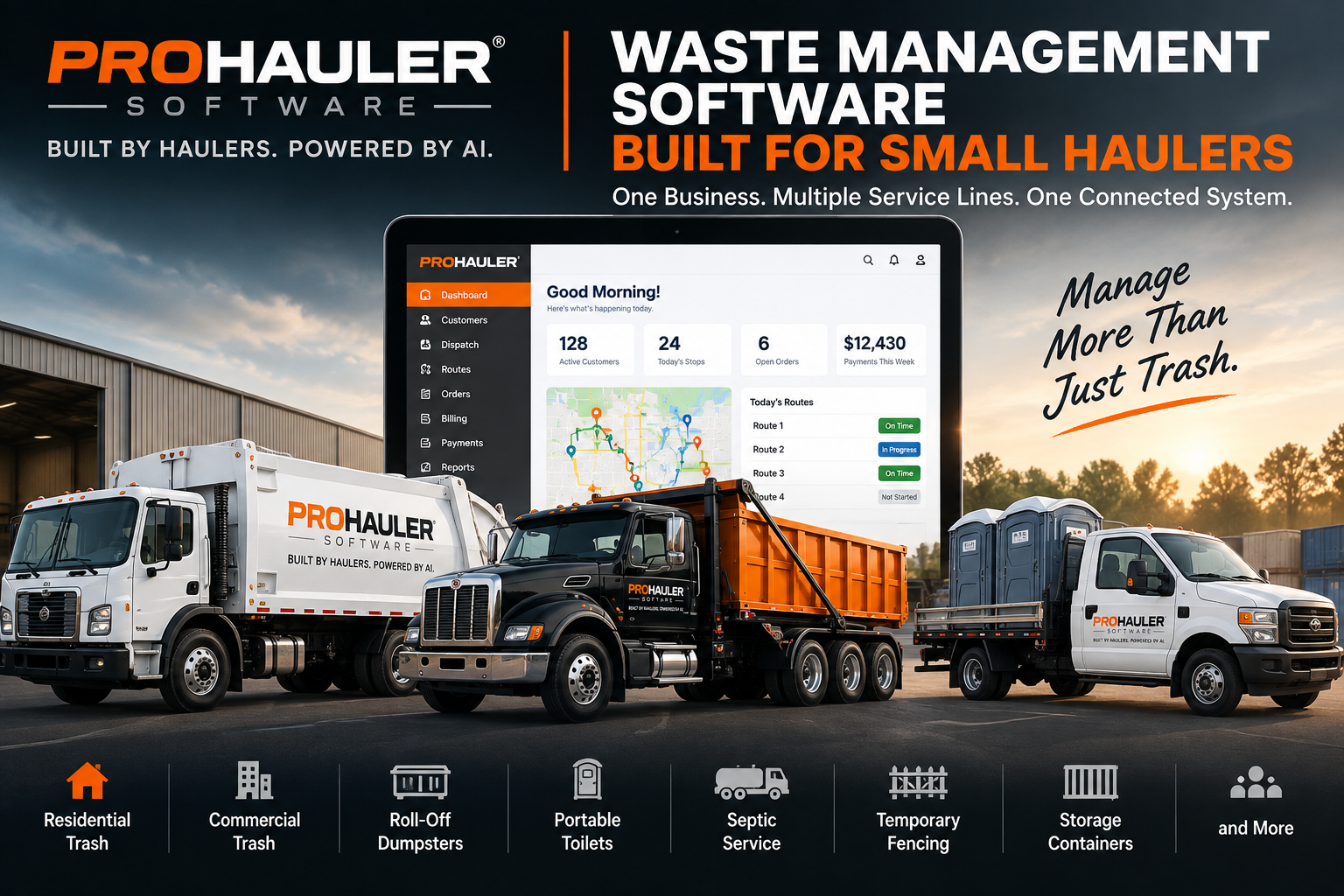
ProHauler Software is specifically designed for waste and site service companies. It supports operations involving residential trash, commercial trash, roll-off dumpster rental, portable toilet rental, septic service, temporary fencing, storage containers and other hauling or site-service operations.
ProHauler is not automatically the correct choice for every waste company, and we would rather you choose it because it fits your operations than because of a marketing claim. The platform is most relevant when a company:
- Operates more than one service line, or expects to
- Wants customer acquisition connected to operations
- Wants to reduce dependence on disconnected software systems
- Needs both recurring and on-demand operational workflows
- Wants a platform capable of growing with the company
- Values unlimited users and fleet-based pricing over per-seat fees
For a related, deeper look at running two service lines in one system, see our article on the best software for trash service and dumpster rental companies.
How ProHauler Connects the Workflow
Rather than listing features in isolation, it helps to see how ProHauler's capabilities connect through an actual workflow:
A prospect becomes a customer
Marketing, website and online ordering capabilities help attract and capture the customer. The prospect becomes a customer inside the same system that will manage the rest of the relationship.
The customer places an order
An online order or office-created order enters the appropriate operational workflow — recurring for trash, on-demand for a dumpster — using the same customer record.
The work is dispatched or routed
Dispatch and routing place the job on the correct route or dispatch board, assigned to the right driver and truck.
A driver performs the work
The driver sees assigned work in a mobile application — recurring stops and on-demand deliveries, swaps and pickups — and completes it from the field.
Billing and payment occur
Recurring subscriptions and one-time charges are invoiced and collected in the same system, connected to the service that generated them.
Customer communication continues
Confirmations, notifications and updates stay tied to the customer record, so the office and the customer share one conversation.
The customer may return or refer
Reviews, referrals and repeat business stay connected to the same customer history, turning completed work into future growth.
The point is the connection between these activities, not simply the existence of each feature. A platform can have a dispatch board and a billing tool and still leave the office re-entering the same customer twice. ProHauler is designed to keep information moving through the business rather than recreating it at every step.
BUILT BY HAULERS. POWERED BY AI.
Questions Small Waste Haulers Should Ask Before Choosing Software
Use this checklist when evaluating waste management software for your operation. These questions are useful regardless of which platform you ultimately choose.
- Does the software understand my specific service type?
- Can it manage recurring services?
- Can it manage on-demand services?
- Can it support more than one service line?
- Can the same customer use multiple services?
- How does dispatch work?
- How does routing work?
- What does the driver see?
- How are invoices handled?
- How are payments handled?
- Can customers order or manage service online?
- How are customer communications handled?
- Does customer acquisition connect to operations?
- Can I add trucks, drivers and office employees?
- Can I add another service line without replacing the system?
- How many additional software subscriptions will I still need?
If the answer to most of these questions is "yes, in one connected system," the platform is worth serious consideration. If the answer is "yes, but only across several separate tools I will have to connect myself," that is exactly the problem a connected operating system is designed to solve.
How AI Fits Into Waste Management Software
AI is becoming part of nearly every software company's marketing. The more useful question is: what can the AI actually do for my business?
AI is most valuable in waste management software when it assists with actual operational or administrative work rather than merely appearing as a label on a feature list. Practical applications include assisting with dispatch decisions, supporting route optimization, answering operational questions using business-specific knowledge, helping with customer conversations, and automating routine front-office tasks.
ProHauler is AI-powered software built specifically for waste haulers and site service companies. AI is incorporated into the operating system to help operators work with the information and workflows already moving through their business — not as a disconnected feature bolted onto a dispatch board. The point is practical assistance applied to real hauling workflows, not a marketing buzzword.
MARKET. SELL. OPERATE. GROW.